- “Etruscan” describes a culture and historical context, not one unchanging visual style.
- Gold ornaments were engineered to look rich while often remaining lightweight.
- Jewelry communicated status, identity, dress, ritual, and participation in Mediterranean exchange.
- Many surviving pieces come from tomb contexts, which shapes what we know.
What the term means
The Etruscans occupied a network of city-states in ancient central Italy. Their jewelry developed over centuries and absorbed ideas from neighboring Italic peoples and the wider Mediterranean. A piece may therefore be Etruscan in manufacture or use while sharing forms and motifs with Greek, Phoenician, Near Eastern, or later Roman traditions.
The most responsible way to understand Etruscan jewelry is to combine object construction, archaeological context, date, place, and comparative museum evidence. Visual resemblance alone is rarely enough.
Why the jewelry matters
Jewelry provides unusually intimate evidence. It rested on the body, fastened clothing, framed the face, sealed documents, and accompanied people into burial. It reveals not only wealth but choices about identity, gender, age, family, ritual, and public display.
The technical achievement is easiest to see at close range: tiny gold grains, hair-like wire, and thin sheet were assembled into surfaces that appear massive, textile-like, or architectural.
A concise chronology
| Period | Approximate frame | Jewelry developments |
|---|---|---|
| Villanovan / Early Iron Age | 9th–8th centuries BCE | Fibulae and practical dress ornaments; foundations of later forms. |
| Orientalizing | 7th century BCE | Rapid expansion of luxury goldwork, granulation, filigree, exotic imagery, and elite display. |
| Archaic | 6th–early 5th centuries BCE | Elaborate tomb groups, disk ornaments, pendants, scarabs, rings, and refined workshop production. |
| Classical and Hellenistic | 5th–3rd centuries BCE | Changing forms and motifs within increasing Greek and Roman cultural interaction. |
Materials and visual effects
Gold dominates modern attention because it survives well and records extraordinary workmanship. Yet Etruscan adornment also used silver, bronze, iron, amber, glass, rock crystal, carnelian, agate, and engraved gems. Makers exploited contrast: matte granulation against polished sheet, dark stones against gold mounts, and translucent crystal against filigree.
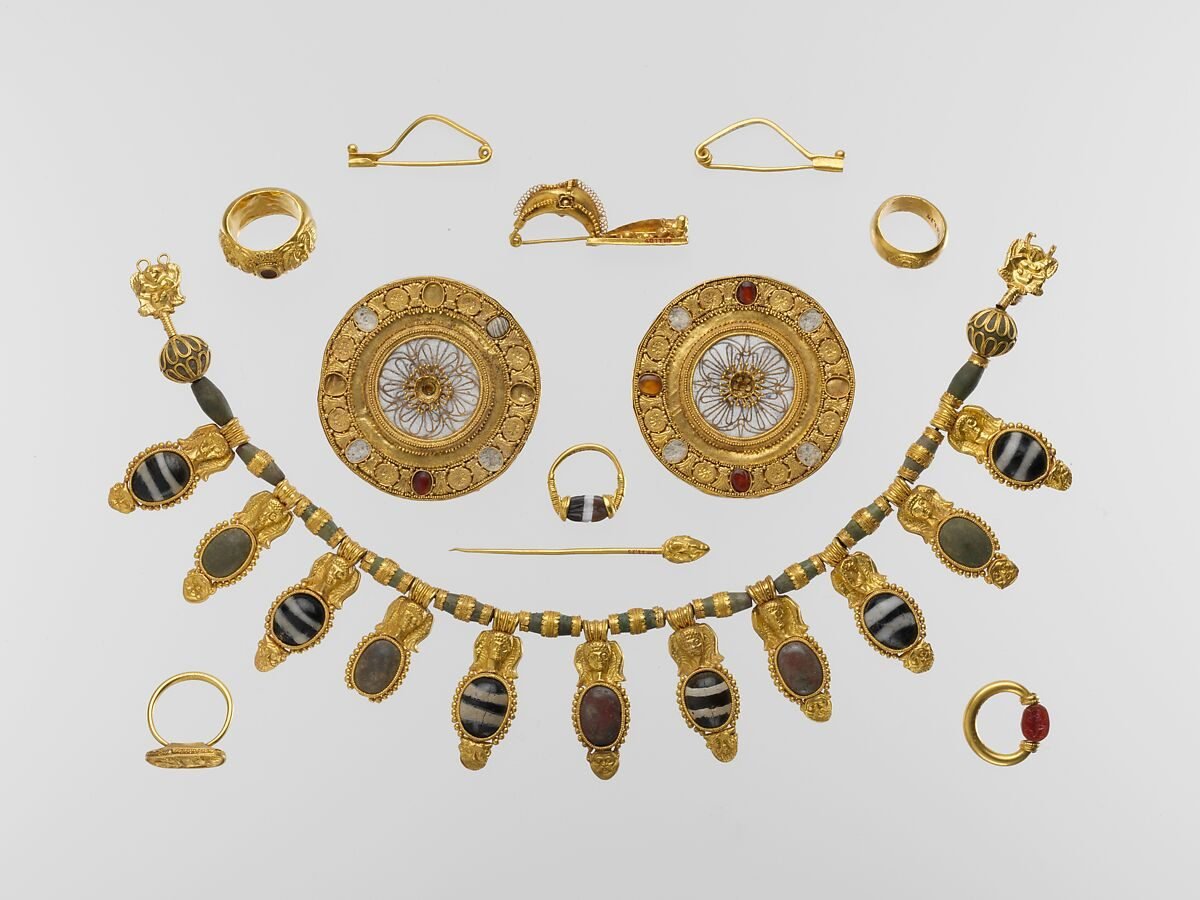
Core goldworking techniques
These methods were often combined. A hollow pendant might begin as sheet, receive repoussé relief, be edged with wire, and then be covered with granulated details. The result can look heavy while using surprisingly little metal.
Major forms
Common categories include earrings and ear ornaments, necklaces and pendants, fibulae, pins, rings, bracelets, diadems, hair ornaments, and dress plaques. The fibula is especially important because it joined ornament with a clear function: fastening clothing.
Jewelry, society, and burial
Much surviving evidence comes from elite tombs. That creates both opportunity and bias. Tomb groups preserve ensembles and associations, but they overrepresent people and families able to commission rich burials. Objects placed with the dead may reflect identity in life, ritual needs, family memory, or a constructed ideal rather than ordinary daily wear.
Why so much survives
Gold resists corrosion, and Etruscan funerary practices placed durable objects in protected tomb environments. At the same time, ancient and modern looting, undocumented excavation, restoration, and nineteenth-century imitation complicate attribution. Provenance is therefore central to serious study.
Where to go next
Begin with goldworking techniques, then compare specific jewelry forms. For a modern object described as “Etruscan,” use the identification guide and remember that style is not proof of ancient date.
Sources and further study
- The Metropolitan Museum of Art: Set of jewelry, early 5th century BCE
- British Museum: Etruscan world
- British Museum: Etruscan gold necklace
- ArcheoSciences: Modern and ancient gold jewellery attributed to the Etruscans
Museum dates and object descriptions can change as research progresses. Follow the linked collection records for current cataloguing.