- Never authenticate from photographs or motifs alone.
- Construction and provenance matter more than “looks old.”
- Nineteenth-century revival jewelers could reproduce ancient techniques at a very high level.
- For valuable objects, consult a qualified specialist and request scientific testing where appropriate.
The three-part test
1. Style
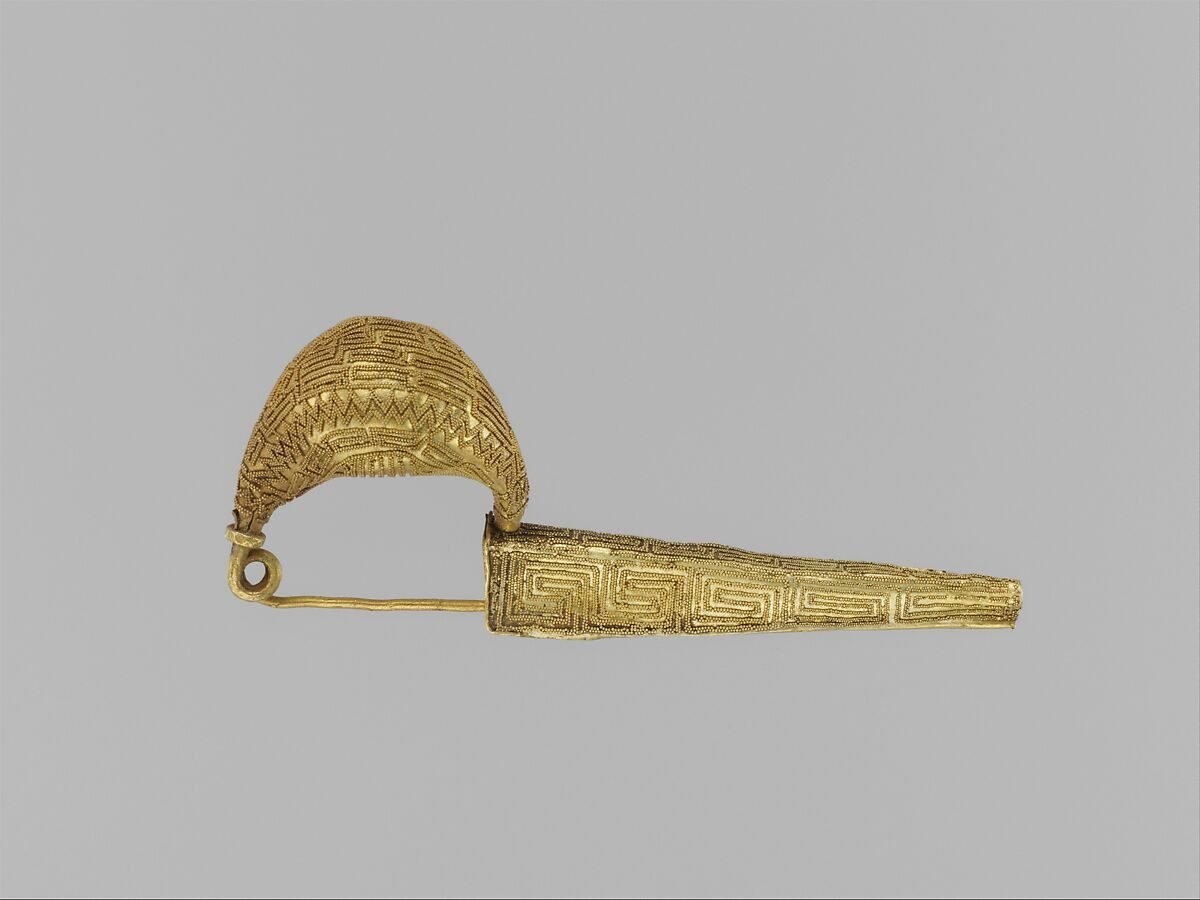
Look for dense granulation, fine wire borders, palmettes, rosettes, animal or mythic figures, pendant chains, disk forms, scarabs, and fibula shapes. These features can suggest an Etruscan vocabulary, but many were shared or revived.
2. Construction
Study seams, joins, hollow sections, wire profiles, grain consistency, pin mechanisms, wear, repairs, and the relationship between decoration and structure. Ancient work can be remarkably precise; crude workmanship is not evidence of age.
3. Documentation
Ask for ownership history, old photographs, auction records, excavation documentation, museum comparisons, prior scholarly opinions, and all testing reports. Gaps do not automatically prove a fake, but confident claims require evidence.
Features seen in ancient work
Ancient gold ornaments may be built from very thin sheet, with hollow or layered components. Granules can form geometric fields, borders, animals, or meanders. Filigree may be plain, twisted, beaded, or arranged in spirals. Wear should make sense for the object's structure and use—not appear uniformly added.
The archaeological revival problem
During the nineteenth century, discoveries in Italy inspired jewelers to recreate and reinterpret ancient designs. Some revival pieces are important works in their own right. They may use genuine granulation and filigree, old-looking gold, and historically informed motifs. The correct label is not “fake” when a piece was honestly made and sold as contemporary revival jewelry.
Red flags in listings
- Claims of ancient date with no ownership history or specialist report.
- Vague phrases such as “museum quality” used in place of evidence.
- A story of an undocumented family find that cannot be checked.
- Artificially uniform dirt or patina in protected and exposed areas alike.
- Modern findings, solder, or tool marks inconsistent with the claimed date.
- Pressure to buy before independent examination.
A practical examination process
- Record dimensions, weight, markings, and every component.
- Photograph front, back, edges, interior, joins, clasp, and damaged areas.
- Find museum parallels with secure dates and provenance.
- Have the object examined under magnification by a jewelry historian or conservator.
- Use non-destructive elemental analysis when the question and value justify it.
- Keep conclusions proportional to the evidence.
Buying responsibly
Ancient artifacts raise legal, ethical, and cultural-property issues. Prefer objects with documented pre-existing collections, lawful export history, and reputable specialist handling. A low price does not reduce the need for provenance.
What this guide cannot do
This page is educational, not an authentication or appraisal. Photographs rarely reveal enough about solder, composition, microscopic wear, repairs, and provenance. A defensible conclusion often requires in-person examination and documentary research.
Sources and further study
- The Metropolitan Museum of Art: Set of jewelry, early 5th century BCE
- British Museum: Etruscan world
- British Museum: Etruscan gold necklace
- ArcheoSciences: Modern and ancient gold jewellery attributed to the Etruscans
Museum dates and object descriptions can change as research progresses. Follow the linked collection records for current cataloguing.